
Image courtesy of Pete Woodhead.
On the 12th of April, I was lucky enough to find myself sitting in the Queen Elizabeth Hall at London’s Southbank Centre. I was there to experience a multi-sensory performance featuring the Bristol-based Paraorchestra and breakout ambient techno artist Surgeons Girl, also based in Bristol. Surgeons Girl’s influences include electronic music pioneer Suzanne Ciani, American musician and DJ Laurel Halo and modular synthesis expert Kaitlyn Aurelia Smith. Surgeons Girl has made waves in the ambient techno genres with critically acclaimed albums such as ‘A Violent Sleep’, ‘The Empress Moss’ and ‘Sever’.
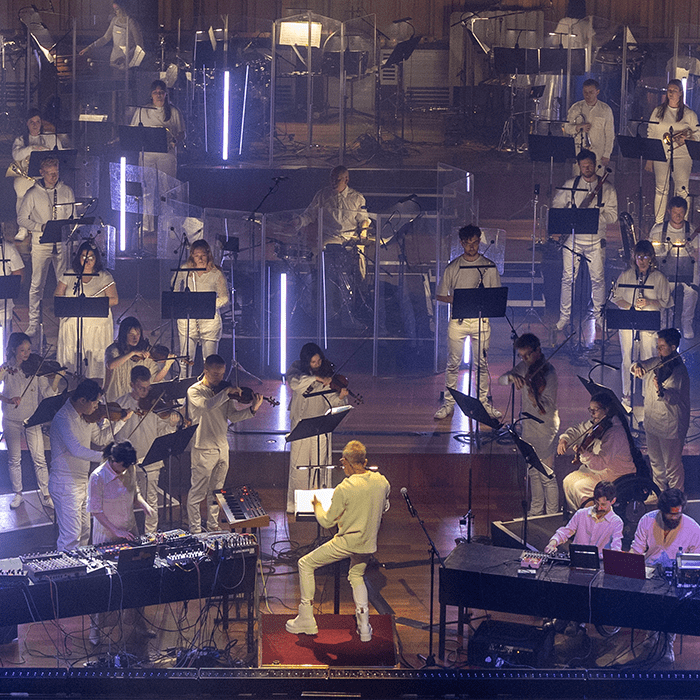
The name given to the concert was Trip the Light Fantastic, a phrase that is originally attributed to poet John Milton and means to dance nimbly or lightly to music. The concert made its debut at Bristol Beacon and was commissioned to celebrate the opening of the stunning new venue. Unfortunately, I was unable to attend the performance at Bristol Beacon, fortunately, another showing at London’s Southbank Centre had been arranged, so I hopped on the train and traversed the cacophony of the underground, eventually finding myself in the busy and expectant Queen Elizabeth Hall. The hall had a modern yet grand ambience with illuminated plumes of smoke acting as a stage curtain, I heard people sitting around me say they wanted to reach out and touch the moving veil. The slight translucency of the smoke was effective at building anticipation as you saw the musicians dressed completely in white take their places. At first glance, the setup looked like a traditional orchestral performance, but looking closer, I could see a range of visual clues that gave away the experimental nature of the performance. Two large tables dominated the front of the stage, one with a large array of electronic music equipment and the other holding computers. Three full drum kits caught the eye at the stage’s very rear along with the instrumentalists’ white outfits being reminiscent of lab coats.
The concert began with a brief introduction from Paraorchestra’s enigmatic artistic director and award-winning conductor, Charles Hazelwood. Among other things, Hazelwood explained the research and development process behind the performance. He introduced the audience to Oliver Vibrans, the corresponding composer. It was the task of Vibrans to integrate the musical ideas from Surgeons Girl, turning them into a format that an orchestra could work with and vice versa.
Prelude to a Beginning was the first piece to be performed. The song was composed by the current musician in residence Asteryth Sloane. This piece of music needed to capture the tension that had already built in the hall and take it to new levels; Sloane shows their talent by not only executing this task perfectly but by creating intrigue and wonder with experimental spacial techniques. Instrumentalists were positioned throughout the hall before the performance began, these carefully positioned musicians fully immersed me within the music. Portamento gave the piece its distinct sonic signature, a sound that I would describe as waiting patiently, much like Surgeons Girl who throughout, gazed with a stillness at the equipment before her.
No matter how much the sliding tones of Prelude to a Beginning kept us on the edge of our seats, nothing could have prepared us for the analogue synthesised storm that was hidden in the shadows. In a flash of light accompanied by huge sonic impacts, Surgeons Girl let loose. In this first section, my startled mind could not piece together who was in charge, the Surgeon or the machine. The visual appearance of Surgeons Girl darting between the vast wired machinery surrounded by an array of bright flashes was comparable to the taming of a monstrous beast. The orchestra had all but disappeared from the audible spectrum until Surgeons Girl began to reign in the crazed impacts and after a while, it seemed that the orchestra had been pushed back to the forefront of the soundscape, once again playing with portamento as if to warn that the serenity would be brief. This prophecy was quickly fulfilled, although this time it was the orchestra’s percussion section that filled the room creating a deafening but steady rhythm that was reminiscent of ancient war drums. The strings once more gave a brief moment to catch your breath before Surgeons Girl returned once more, however, this time the steady drums relentlessly followed the synthesised impacts creating a blur between the digital and physical. This blurring effect became ever more apparent when the full orchestra seamlessly integrated itself into any gap that was left unfilled by the digital synths and physical percussion. The level of talent that was displayed in this section cannot be understated as every musician, producer and lighting engineer appeared to be tuned perfectly with one another creating the incredible effect that the sound wad emanating from a single entity. This allowed the performance to effectively pull off the illusion of cause and effect whereby an impact produced by Surgeons Girl’s synths would seemingly cause a physical change within the orchestra.
Throughout the performance, Surgeons Girl’s skill and knowledge of modular synthesis equipment were evident from the way that she seamlessly glided between equipment with uninterrupted attention, focus and purpose. The orchestra demonstrated their talent in the ability to both assist and challenge the techno elements created by Surgeons Girl.
After this exquisite display of physical and digital blurring, the orchestra took a step back and allowed Surgeons Girl to completely fill the room with her signature sound of ambient techno, demonstrating that she had gained full control over the chaotic soundscape that started the performance. Throughout this section, all eyes in the audience and on stage were fixed on Surgeons Girl’s every move, the mesmerizing tones that were crafted before our very eyes filled the hall with a sense of wonder. Once more the orchestra seamlessly integrated into the soundscape and gradually began to create an auditory representation of majestic ascension. Surgeons Girl’s and Conductor Charles Hazelwood’s movements appeared to be synchronised, the music rising continuously until it reached a point at which it could ascend no further, silence descended but to the delight of the audience, the performers started anew.
It was at this point that I put down my pen to soak in the remaining performance. The partnership of Surgeons Girl and the orchestra had become complete. The rising and flowing movements of the experimental performance now sounded natural, captivating every sense and sensation. The performance ended with a triumphant bang that produced a standing ovation, thunderous applause, cheering and shouts of bravo which was the only suitable reaction from the delighted audience.
As I left the hall and made my way back to the tube station I felt a great deal of excitement at what I had just witnessed. I believe that the potential that has been realised in this multi-sensory performance creates an exciting new way to experience electronic music and its integration with what is considered by many to be a more traditional form of music and performance. I excitedly await more from both Paraorchestra and Surgeons Girl and have no doubt that this kind of experience will continue to surprise and delight audiences for a long time to come.
For more, you can listen to Surgeons Girl’s Trip the Light Fantastic Special show on SWU FM where she also has a monthly show.
More information about the incredible work of Paraorchestra can be found on their website.
 Voltage Controlled Media